
Tribute to Lama Yönten
Having met Lama Yönten (Yönten) when he came with Dilgo Khyentse Rinpoche to Colorado in 1975, I was delighted, when I arrived in Kathmandu to live in 1994, to discover that he was my neighbor in the Boudha community. I connected with him there and saw him often. He would be at khora (circumambulation) every day. For a few years, I was living right on the Stupa, so when I opened my window and looked down at the crowds of people streaming around the Stupa, I usually saw Yönten within a couple of minutes. Except when he was away doing business in Darjeeling or elsewhere. Quite possibly selling sweaters, a common occupation among the Tibetan diaspora. If I didn’t see him for a while, when he did appear at khora, I would join him and catch up.
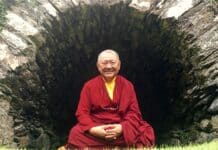
Yonten’s room at Dapzang Monastery was tiny. He had a simple wooden plank bed, a small bureau at the head of the bed with a shrine on the top crowded with photos of his teachers, a one-burner gas stove, and a plank for visitors to sit on. He lived very simply, cooked his own food, and in his final years when it was difficult to go to khora, sat outside in front of his room in a chair telling his mala or just sitting. Whenever I visited him, he would make some tea in his one pot, and offer some biscuits from a tin. He was always cordial.
Rabjam Rinpoche offered Yönten a much bigger, better room at Shechen Monastery, with meals and any help he might need. But Yönten declined the offer, preferring to stay in his tiny room. It was, I mused, his meditation cave.
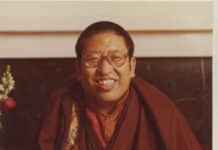
Yönten held heroic stature in my mind. He had been attendant to Trungpa Rinpoche from when Rinpoche was a very young boy. He had trained with Rinpoche as his root teacher while everything was still intact at Surmang Monastery in Tibet. When Rinpoche left to escape the Chinese Communist invasion, with the initial group of refugees, a detail of Chinese soldiers came behind in hot pursuit of Rinpoche and the group. Yönten, an excellent horseman who knew every mountain, valley and trail in the area, was able to fool the soldiers and divert them onto another trail. He saved Trungpa Rinpoche and the group from capture and possible execution. At the immediate risk of his own life. He then caught up with the group and was instrumental at every turn in the escape and eventual arrival in India. He stayed with Rinpoche devotedly until Rinpoche left for the West. I cannot imagine how sad and heart-broken Yönten must have been when Rinpoche left for foreign lands.
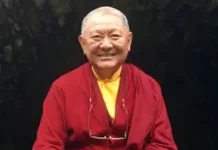
When I visited Yönten, he was always humble, warm, hospitable, engaging and ordinary. It was like visiting a favorite uncle. And he felt like the closest of sangha kin, which he was.
After moving to Sikkim for five years then returning to the USA to live, I traveled back to Nepal now and then. I always visited Yönten. We would have tea and catch up or I would take him out for a meal. At one point, I introduced my wife Pemba to him, which made me incredibly proud that they could meet.
One year when visiting Yönten he and I went out to dinner around the Stupa area. After dinner we were walking quietly along a street when suddenly Yönten exclaimed “I’m old now!” I said back to him, “If you can still appreciate the nice figure on a passing woman, then you’re not old.” Then a few moments later I apologetically backtracked, saying “Oh, I’m sorry, I shouldn’t be talking to you about such things!” Yönten looked at me with a mischievous smile and a twinkle in his eyes and retorted “Why not?”
Last March of 2025, I was honored to take a few old dear sangha friends who had never been to Nepal around to the sacred sites and monasteries of Boudha and the Kathmandu Valley where I had lived for nine years. We visited Yönten at his room, crowding into the very limited space. We thanked Yönten for saving the life of the Vidyadhara. It was very touching for everyone, including Yönten. Every pore in his body and being was saturated in devotion, and his entire life was that of service to his gurus. A singular figure who had meant so much to the Vidyadhara and to us who were gifted beyond measure with meeting the Vidyadhara. As David Darwent noted recently, “Without Yönten no Trungpa teachings. We will always honor him and be grateful for his influence in our lives.”
Several days later, shortly before departing Nepal, I stopped in alone to say good bye to Yönten. He was there at his usual station, sitting alone outside his room. After a few words, I bid my farewell and started for the front gate of the monastery. Yönten called me back and redirected me to first circumambulate the large stupa at the back of the monastery grounds, then around the main shrine hall. After coming around the final curve of my circumambulation, I stopped at the front gate and looked back at Yönten from a distance. We waved, then I left. That was the last time I saw him.
