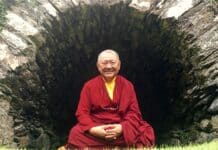
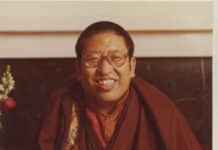

In 1975, when Chögyam Trungpa Rinpoche was asked how he saw his lineage continuing in America he replied that “the general plan, seemingly, or general intuitive plan, is that some kind of reign of sanghaship would take place for a while,” and “this needs group spirit.”
The Halifax Shambhala Centre is implementing a new governance model. The name “Mandala” means “complete world.” Literally, it means society or group. Trungpa Rinpoche famously referred to it as “orderly chaos.” The Mandala Model is self-governing, creating order and clarity about what we are doing and where we are going. By its nature it is a horizontal structure, encouraging participation from many divergent voices.
This model organizes the activities of the Shambhala Centre into groups called circles, which have aims (clearly stated purposes) and domains (areas of responsibility). There are now four Standing Circles: Practice and Education, Centre Operations, Community, and Internal-External Affairs. A Central Circle made up of two members from each Standing Circle coordinates these four domains and holds the Centre’s overall view.
Circles are groups of people who work together and decide how the work is to be done. Each one is small enough so that all circle members are heard, optimally made up of 5-8 people. Circles set their own aims and manage the work within their domain. They are supported by sub-circles when clusters of tasks increase in complexity, like the Holidays sub-circle of the Community Circle. Helping circles arise temporarily, for a specific purpose, within a specific time frame, like the visit of a teacher. The circles have started out with people already engaged in the activities, and over time have drawn in new members.
Decisions, both short term (operating) and long term (policy), are made by a process of consent, different from consensus. A consent decision is settled upon when no circle member objects to the terms of the proposal (“That works for me now.”). Any proposal requires exploration and working through objections. This process ensures that all circle members’ concerns are considered and addressed.
The goal of this model is to enhance a sense of community and connection. It is not merely a matter of rearranging an organization chart or adopting new meeting procedures. This represents a fundamental shift in organizational culture and requires patience, persistence, and willingness to learn. We will know it is successful when we are able to see some specific results. For example, does it address some of the chronic problems we have experienced in our traditional organizational structure, like low community engagement and burnout of staff? Does it effectively replace the hierarchical Executive Director form of governance? Is it effective in carrying out the Centre’s mission? Does it offer a transparent process for governance?
Halifax is not alone in working to establish this type of governance model. We have benefited from other Shambhala Centers, notably Philadelphia and Denver, who have shared their experience and expertise in this model, based on the principles of Sociocracy. We are indebted to them for their help.
For questions please contact Bob at bob.vogler@gmail.com.