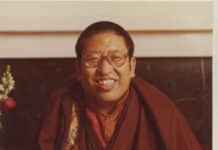
In December of 2020, during the pandemic, the Philadelphia Shambhala Center hosted a virtual gathering with fourteen of the founding members of Shambhala in Philadelphia. Coming together from coast to coast, some of them had not seen each other for decades.
They talked about the early days of practice, the sangha house in West Philly, the visits of Chogyam Trungpa Rinpoche, and reminisced about their shared experiences of being dharma pioneers. That gathering was recorded, and this booklet is an account of their conversation.
We are grateful to all of them for telling their story and for their continued commitment to the dharma.
The Seed is Planted
In the mid-1970s, a small but determined group of practitioners planted the seeds of what would become the Philadelphia Shambhala Center. It began with Ralph Basch, who had spent time at Naropa University, founded by Chögyam Trungpa Rinpoche in Boulder, Colorado. When he returned to Philadelphia in 1975, he reached out to Karen Roper, who was then at Naropa, and asked for names of people in the area who had shown interest in meditation. “I thought maybe there would be some people that would like to meditate together,” Ralph recalled. He called a few people, including Ann Shaftel and John Brown, and a group of five gathered in a room at the Pennsylvania Academy of Fine Arts.
The fledgling group quickly grew. They sent out a letter to a mailing list of 77 people, and around 20 showed up in Elizabeth’s basement in Merion. Initially, they met in different homes until they decided that they needed a more stable space.
At 17th and Locust there was a shop called Dandelion where a Zen group had a small shrine room on the second floor. “In 1976, we rented the shrine room for one night a week and Sundays,” Ralph recalled. “That’s where we started. We had a place that we called our own twice a week. I used to give instruction on the stairs outside of the room that we rented. When I was at Naropa, I said to Rinpoche, ‘I’m going back to Philadelphia. Do you think I should be a meditation instructor?’ and he said, ‘Yeah, talk to him,’ and he pointed to David Rome. So David and I had a little conference, and that was it.”
Scott and Nancy McBride, who would become key members, arrived around this time. “The first time we showed up, we sat a nyinthun, an all-day meditation, 9:00 AM to 9:00 PM.” Scott said. These intensive practice sessions became a weekly core offering for the group.
From Seed to Sangha
John Brown had a trans-Atlantic path to discovering the teachings of Chögyam Trungpa Rinpoche. “In 1973, I spent the summer in England at Oxford College,” he said, recalling that he stumbled upon Naropa’s catalog there and recognized some names—Jose and Miriam Arguelles, Gregory Bateson, Allen Ginsberg, and then “this guy called Trungpa.”
In 1975 he found himself at Naropa, captivated by Chögyam Trungpa’s lectures. At Naropa, John met an art teacher from the Philadelphia College of Art. She said, “You know, there should be a center in Philadelphia.” Soon after John’s return to Philadelphia, Ralph Basch arrived, and the group began to take shape.
Ann Shaftel had an even more circuitous route to the group. “In 1970, I went to India and Nepal, and I met many great teachers, including His Holiness Karmapa XVI. He told me that I should preserve Buddhist art, thangkas, and other things, as my dharma work for this lifetime, but I better do a good job of it and not to do it for the money. I went to
Trungpa Rinpoche and said, ‘What does he mean, not to do it for the money?’ And he said, ‘Don’t do it just for the money. I want you to get as many graduate degrees as you can. You must be the best.’ I had finished one degree and Trungpa Rinpoche would say, ‘Get another degree.’ At the time I was involved in Philadelphia, I was studying at the Winterthur estate and I was in Philadelphia to do some work on thangkas at the Penn University Museum. I was very devoted, so I would go with Ralph to New York or to Karme Choling just for the weekend or for a night to hear a talk. Then I’d have to stay awake for the entire week at graduate school.”
Establishing a Practice House
As the group grew, it became clear that they needed more than a twice weekly rented space. Jonathan Herson recalled, “We figured the only way we could get our own place was to have it be residential and a meditation center at the same time.” In 1977, they found a large house on 48th Street in West Philadelphia, with seven bedrooms and enough space for a dedicated shrine room.
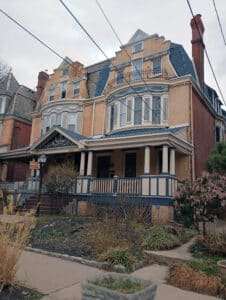
“Our lease started on New Year’s Day,” John Reynolds remembered. “Everyone else was out of town for the holidays. We’d made an agreement with the landlord to remove the plaster from a brick wall on the interior wall of the house, so when I moved in there was a quarter inch of white plaster dust that covered the entire house. I had to mop the hallways, the stairways, the bathroom, the kitchen, the shrine room, three or four times before you could walk in them without raising a cloud of dust.”
The house became a true dharma space, with daily sittings and frequent nyinthuns. “It was a real practice house,” Nancy said. “The living room was the meditation hall.” The commitment was serious. “We opened it to the public every weeknight, and we had nyinthuns every Sunday,” Scott recalled. Over time, the schedule intensified to include nyin thuns on Saturday twice a month, as well as weekly on Sunday.
Margery Lynch had been to Naropa in the summers of 1976 and 1977. She moved to Philadelphia for graduate school, choosing Penn because she knew there was a Dharma Study Group in Philadelphia, but not knowing where it was. She found an apartment and, a few days before school started, she looked in the phone book to find the group. “I discovered that I was a block from the Dharma Study Group house! I knocked on the door and John Brown came downstairs and invited me up to where Ralph was teaching a class on the Twelve Nidanas. People have their stories about books falling into their laps, but mine was that I unknowingly moved a block away.”
Although there were a lot of other intentional community living spaces and plenty of progressive and radical movements active in West Philly at that time, the 48th Street group didn’t engage much. “We kind of fit right in,” recalled Nancy. “But we were also insular,” added Ralph. “We were on our own track.” However, they were not invisible. Michael Baime lived across the street. He noticed people walking around in a circle in the living room. One day he knocked on the door and asked, “Are you people meditating?”
The residents covered the rent, but the group needed additional funds to support their programs. John Reynolds was in a rock band, The Dooka City Band, that played a benefit. “We broke even,” said Ralph. “No, we lost money,” corrected Jonathan, “but we had a great time.” The porch sales were more lucrative. “We would raise $400 to $500 from those things somehow,” Scott recalled.
Posters were the main means of spreading the word in those pre-Internet days. “I remember Michael Tawney going up and down the street in West Philly, singing songs and putting up posters,” recalled Ralph. Bill Wagner added, “My wife, Susan, put up a poster for a class on working with emotions, which is how I met her.” Alex Anderson chimed in, “After I joined, my job was to put up posters and I put up a poster on the same bulletin board as Susan did, and my wife Kitty was studying religion there, and she saw it, and that’s how we found each other.
It wasn’t all practice and no play on 48th Street. Saturday night became Saturday Night Live night. Back then, it was a brand new show and Ralph was the only one with a TV. His mattress was on the floor, 70’s style, and they would all gather around. “The Johnny Walker would come out and we were pouring shots and watching Saturday Night Live,” Scott recalled. “We would just laugh and have a great time.” “And you did a great Steve Martin impression—a wild and crazy guy,” Larry Ladden added.
The 48th Street house also became a hub for visiting teachers. Jeremy Hayward was the first to visit there. “I remember meeting Jeremy at the car,” Ralph recalled. “I was out front waiting for him to arrive, and I reached out my hand to shake his hand, and he put his briefcase in it.” One of the most memorable visits was in 1977 from the Vajra Regent Osel Tendzin, Chögyam Trungpa’s Dharma heir.
“We all sat in the shrine room in a big circle on the floor on this red carpet and had takeout Chinese food,” Ralph remembered.
But the visit was more than casual. Scott described the lead-up to the visit. “In a sense, Philadelphia was always a satellite of New York. We were always piling in the car and going up to New York. In terms of the big stuff going on, that always happened in New York, Boston, L.A., San Francisco, Washington, and we were in the shadows. But we knew the Regent was going to be in New York, and we just pleaded, ‘Can he just come down and bless our center?’”
Because they pleaded, the Vajra Regent came to Philadelphia to bless the space. He blessed the shrine room, and then he went upstairs. “He kept saying Om Svabhava Shud dha Sarva Dharma Svabhava Shuddho Ham over and over, everywhere,” Scott recalled. “He just kept saying it, everywhere he looked, Om Svabhava Shuddha Sarva Dharma Svabhava Shuddho Ham. He did something to the space. His mind blessed that space.”

Connecting with the Center of the Mandala
The visit from the Vajra Regent strengthened the group’s connection to the center of Chögyam Trungpa’s mandala, which was then in Boulder, Colorado. “We actually started out as a Dharmadhatu, and then the first Dharmadhatu Conference happened where they created the idea of Dharma Study Groups, pre-Dharmadhatus, so we got downgraded,” Ralph remembered. “When we arrived, it was a Forming Dharma Study Group, a pre-pre-Dharmadhatu,” Scott corrected, “and then I went to the conference and we became a Dharma Study Group. When Dan and Meera arrived, we went to the conference and put the thumbs on them to make us a Dharmadhatu.”
Dan and Meera Meade’s arrival in 1978 was the result of the group’s request for an emissary, a person who would act as an intermediary between what was happening in the local center and the center of the mandala. Meera recalled, “Dan, as we know, was a very ambitious young man. He spoke to Chögyam Trungpa and said, ‘Well, what should I do now?’ Rinpoche said, ‘Well, you can be an emissary.’ And we were given a choice. We could go to Santa Barbara or to Philadelphia. And we chose Philadelphia. We thought it would be fun to be in a big city.”
“A lot of energy came with Dan and Meera,” recalled Nancy. “Their arrival provided the juice for our expansion. It was a whole new phase for everything,” Scott added. “We now had a forming tantra group, budding ngondro people, and Dan and Meera could teach us. We didn’t always have to get someone from the outside. We were like hungry chicks, and Dan and Meera were feeding us with all this wisdom, all this teaching, and stories of the center of the mandala.”
Dan and Meera weren’t the only ones teaching. In 1975, Vajradhatu sent out packages of course syllabi, including one called “The Battle of Ego.” Alex Anderson remembered seeing a poster for that talk on the Temple University campus and going to the first public talk given by Scott, who remembered that occasion. “I had studied and studied and studied. I had my notes on three-by-five cards, and my hands were shaking, I was so nervous. Because how could this guy speak the dharma? By nature, I’m more of an introvert. I had to deal with my social anxiety. So, in the spirit of the Vidyadhara, I had a couple of swigs of sake to help me along so that I’d have the courage and have the lungta to actually get through it.” He must have done a pretty good job, because most of the people at that first public talk are still around and practicing.
Growth and Expansion
The group’s growth eventually necessitated a move to a more public location. “We needed a neutral space,” Jonathan explained. “Living and practicing together created an in-crowd and an out crowd. We were inviting people into my living room and my kitchen. We weren’t advanced enough practitioners to pull that one off, but we were smart enough to know it, and to say, we can leave this as a practice house for residents and get a completely public space.”
In 1979, they moved the public events into an office building at 1015 Chestnut Street, across from Jefferson Hospital. “We could see right into the hospital rooms. You could see people lying in their beds,” Margery recalled. “It was a powerful reminder about practice.” With new leadership, a continued commitment of the founding members, and a new space, the group was able to offer more classes, programs, and retreats.
The Dharma Settles in Philadelphia
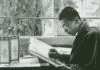
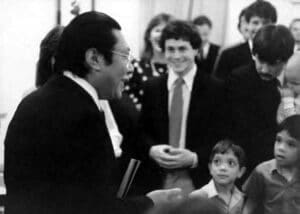
By the early 1980s, the Philadelphia Dharmadhatu had firmly established itself. They offered the first Shambhala Training level in Philadelphia, taught by Peter Lieberson, who had been appointed by Chögyam Trungpa to direct Shambhala Training in North America. The group moved again, to 2030 Sansom Street in 1981, and in 1983, Trungpa Rinpoche himself finally visited. He stayed at Mary Davis’s mother’s house, where he composed the first of the Elocution Lessons, “Kathy’s Hair is Black.” Dan Meade wrote about that visit, “His talk was wonderful and charmed the crowd. As we left, he asked me about people in our community; he wanted to know every detail about every man, woman and child.”
Legacy and Reflection
Looking back, the founders recognized the unique energy of those early days. “We were family,” Margery reflected. Larry added, “I’m grateful for our community that supported the radical gesture of just being still. I feel that gratitude every time I sit down to practice.” “It changed my life forever,” John offered. “The dharma, the lessons of impermanence and dukkha, and, like Larry said, the power of just sitting still.” The community continued to evolve, and the teachings spread beyond its original founders. Some members moved away, others stayed, and the dharma continued to shape lives.
Today, the Philadelphia Shambhala Center is part of a broad network of meditation centers. But those who were there from the beginning remember the sheer determination and heart that made it all possible. The seeds planted in someone’s basement, in a rented Zen shrine room, and an old house on 48th Street have grown into something lasting—a refuge for those seeking stillness in a chaotic world.
Written by Jude Robison in 2025, drawn from the recording of the Founders’ conversation in 2020.